Architecture Overview
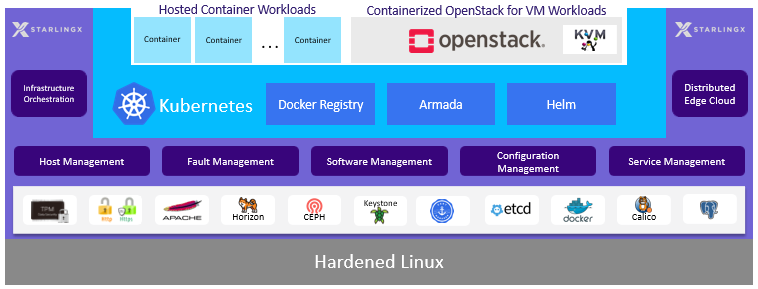
StarlingX OpenStack uses a layered architecture in which OpenStack runs as a containerized Helm application on Kubernetes, StarlingX orchestrates Kubernetes, and the entire stack runs on a hardened Debian Linux base. This design isolates each layer’s concerns while enabling unified lifecycle management from bare metal through virtual machines.
The diagram below illustrates the high-level StarlingX architecture:
Hardened Linux
The foundation layer is a Debian Linux kernel and operating system tuned for deterministic, low-latency performance. Wind River maintains this layer with ongoing security CVE patches to meet carrier-grade and enterprise compliance requirements.
StarlingX Platform
StarlingX provides hardware and software infrastructure management for the entire stack. It handles:
Installation, maintenance, and fault monitoring of dedicated bare-metal servers
Configuration of hardware and software services running on host servers
High-availability cluster management for controller nodes, including critical-service monitoring and automatic recovery across all nodes
Fault and log monitoring and reporting for both hardware and software services
Software update management across all layers, including the kernel, operating system, open-source packages, StarlingX, and Kubernetes
Supporting open-source components at this layer include PostgreSQL for platform databases, Ceph for persistent storage, Etcd for distributed key-value coordination, and Apache for web services.
Kubernetes
Kubernetes provides container orchestration for the application layers above it. Key capabilities include:
Native container runtime for workload execution
Calico container networking, with accelerated networking through multus and SR-IOV CNIs
Persistent Volume Claims backed by Ceph storage
Local container image registry
Helm package manager for deploying and upgrading containerized applications
FluxCD for GitOps-based continuous delivery
OpenStack
OpenStack is the top layer and provides virtual machine lifecycle management. It deploys as a set of containerized Helm charts on the Kubernetes layer, leveraging the platform’s high availability and lifecycle management capabilities.
For details on individual OpenStack services, see OpenStack Services.
